Does Motherboy XXX, Afternoon Delight or The Queen Mary mean anything to you?
Who do you first think about when you heard the names George, Lindsay or Buster?
If you think Arrested Development, you're in good company and we should be friends. If it wasn't, please go to Netflix, Hulu, Best Buy or your local library and buy/rent/stream/borrow one of the best television shows in recent memory.
Netflix is about to premiere their latest Netflix-only show, a final season of Arrested Development. Fans of the show have been waiting for this season for many years, hoping that someone, anyone would pick-up the show and create new episodes. In one of the last episodes aired on Fox, the writers actually wrote into the script the characters pleading to HBO, The Home Builders Organization to save the family business.
Netflix's goal is to now spread awareness and attract non-subscribing fans of Arrested Development to their service. One really inventive way they've used digital marketing is through their partnership with Seamless web.
Netflix has partnered with seamless by inserting Bluth's Original Frozen Banana stand as a restaurant you may order delivery from. This is incredibly clever and innovative. The promotion gets even more fandom-worthy when you view the menu.
Marketers would do well to take note of this example. It's a great way to connect with customers and stir up even more fervor for an upcoming premiere.
Also, as a note... Never give up animation rights.
There are 10 types of companies in the world. Those who understand digital and those who don't.
"Being digital" is the saying-du-jour for most companies. Companies believe that being digital is WHAT they have to do but they have no idea HOW or WHY. Companies looking to dip their toe into the waters of the digital world (or even those who have been in for a while) need to analyze what I feel are the five key points of any digital campaign.
Audience
You have to know your audience. This is the key for any campaign but something that can be easily lost sight of when focusing on digital. Companies may think that since it costs nothing/little to be on facebook/Twitter/Instagram/Google+ and the list goes on that you should have a presence on there. You shouldn't. Where are your customers? The customers must be the center of every campaign. If you're selling acne medication, it will not be effective to buy ads on LinkedIn. If your desired demographic is male, Pinterest would not be the place to have a page. You can't be everything to everyone and you can't be everywhere else you'll be seen nowhere.
Expectations
The next crucial aspect to understand is setting the right expectations & goals for the campaign. If you don't have what you expect to achieve from the campaign set at the get-go, you will only meet disappointment. With digital marketing it can be even more difficult to set concrete goals and benchmarks since there is rarely a direct path from the customer to the company. You may be looking for increased orders, to build your email database, or for people to donate money; whatever your goal, set the benchmarks and measurements that you're able to capture and use. You will use your set goals to influence every action that the company does from here on. If an action/medium doesn't fit your goal and reach your desired customer; don't do it.
Story Creation/Authenticity
Now comes problem the most difficult aspect for companies to get their heads around - content. This is where the company receives its voice and talks to its customers. You want to intrigue the customers - entice them to learn more about your product/service.
All your communications, whether tweets, facebook updates, YouTube video or banner ads, must match the tone of your brand. It must seem authentic to the customer. No one will trust a "serious" brand that makes slap-stick commercials or sarcastic tweets. To the left is an example of good content creation by Irrational Games for Bioshock Infinite, "Columbia, A Modern Day Icarus?" This video hits perfectly with the demographic of the game, 25-35 year old males. It's reminiscent of the informative videos shown in science classes around the country in the 70s and 80s
Below are a series of TED talks that give insight on storytelling and how to be a better storyteller.
Social
If corporate heads don't say the words "We need to be digital" than a large percentage of the remaining time they will say "We need to be social."
I want to emphasize that "being social" doesn't just mean being on a social network. You can be on facebook and twitter but if you're not engaging your followers - not being social - then you're not doing it properly. You will need to set up the campaign with more than just tweets of "Buy our product," "Sale Today," "Come to our store." You need to start conversations with your followers. Go back to the true meaning of social.
Mobility
Finally, once all the content is done and created, companies have to ensure that their customers see it. As I discussed in my previous blog post, "Call and Respons(iv)e: Responsive User Design," people are increasingly using smartphone and mobile devices as their primary devices. This means that a website that has been created for a PC/laptop may not have a similar user experience when being viewed by someone on the tablet. Here is an example of the Bioshock Infinite website viewed from a smartphone. The banner is un-scrollable. You're not able to scroll to the "Buy Now" or forums links on the site. #mobilefail When creating websites, or any content, ensure that it is viewable from any device. You want your customers to be able to view you wherever they are. Keeping these five aspects in mind when creating a digital campaign will bring you a long way to ensuring it's a successful one. So, Remember... Identify your audience. Identify your voice. Use it.
2013 will not be known as the Year of the Snake. Nor is it a year until the 2014 World Cup in Brazil or the Winter Olympics in Sochi. It also isn't the year of my 31st birthday. Ok... it is ALL those things but more importantly according to Mashable, 2013 is...
If you’re not familiar with the term responsive design,
in simple terms, it means creating websites that adapt to whichever medium it’s
being viewed on.
Responsive design has come about as the usage of devices with various dimensions - smartphones and tablets have increased. You'll see that in less than two years, Smartphone usage increased from 29% to 50%. This increase in smartphones has also been accompanied by tablet sales looking to overtake PC and notebook sales.
This means that companies designing websites for just the PC are going to bring a poor user experience to their customers, unless you love the annoyance of scrolling left and right just to read a page.
Above is the website for the video game developer Square - Enix. The website delivers a pretty dull - useful but dull - utilitarian user experience. On paper, it should be a great site. It has sections for community news, social media feeds, even a section to find concert locations where music from their games will be performed. In reality... not so much. To be fair, it does have a floating left scroll bar but that's hardly cutting-edge responsive design.
To get a real sense of how responsive a website is, you need to move from PC/laptop to phone & tablet browsing.
Now here is the same page as viewed from phone browser... sigh...
The website on the phone is identical to the browser version. You must scroll up/down/left/right to view the page in its entirety. This is a poor example of responsive design. There are no differences between browser and phone. For this to be a true responsive design, the site should have been minimized for the phone, banner head picture shrunk and made to one fewer column.
What few things the browser page had going for it have gone out the window with the mobile page. You still have the floating scroll bar with the mobile navigation but everything else remains the same. This site becomes even less useful when trying to view it from a mobile device.
It is becoming easier and easier for companies to create response sites so the fact that sites do not make it becomes that much more egregious. Companies, get with the picture!
Do you have any favorite examples of good/bad responsive design?
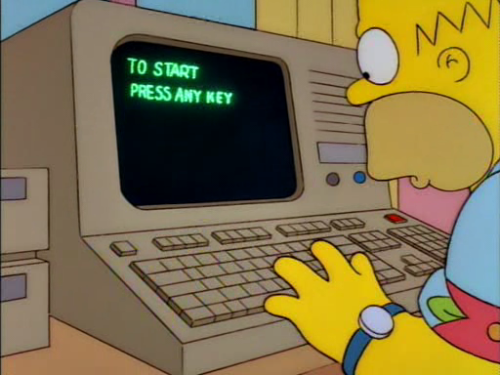
User experience has come a long way since the "dark ages" of DOS and the "any" key but there is still much progress to be made by many companies. To be successful, a company must engage customers and enable them to find what they're looking for in an easy and efficient manner.
A recent Mashable interview of Kare Anderson by Brian Solis, "Why Emotion Makes For Great Web Design" discusses the science behind a better user experience, specifically the science of emotions. Anderson relates how understanding behavior cues in interpersonal relationships can help businesses provide a better experience between business and customer online.
Better Listener
Anderson's talking points all boil down to the basic fact that companies (and people) need to be better listeners.
Increased internet activity and the resulting "screen face" as she calls it are preventing people from truly connecting and being great listeners. She points to the popularity of Susan Cain's Quiet: The Power of Introverts in a World That Can't Stop Talkingas a sign of people's increased feelings of introversion and isolation from others. If you read my post "Do I Fascinate You? Do I?!," you'll remember that as an INTJ this book hits close to home.
Two cues Anderson mentions that I think are particularly true for combating this isolation and making for a better user experience is for a company to
"find the sweet spot of mutual benefit"
"get specific sooner."
Mutual Benefit
A company will be unable to achieve these points unless they are actively listening to their customers. Customers will be turned off by a company if all it does is push advertisements and self-serving ads/tweets/facebook posts. Companies like Pampers and Kraft have been successful by creating content that benefits the consumer without the appearance of being self-serving.
Customers appreciate when they feel that the company is there to help them whether it be soon-to-be or new parents looking for advice or a gamer looking for the newest game release.
Specific
The quicker a customer can find what they are looking for, the better an impression the company will make.
This page is a moderately successful showing of a good user experience. The page is set up so you may find games by platform, genre, release date and more, which allows you to find games by franchise, ESRB rating and type of gameplay. You are able to make a selection in each of the drop-down boxes allowing for a cross-reference and narrowing to a game that fits your criteria.
This page also makes good use of white space, not too cluttered and features large graphics making it easy for gamers to find what they are looking for quickly by multiple methods.
Companies who master these two cues will find their customers happy and happy customers are loyal customers.
So this is crazy but did you know there are things called search engines and people use them to find things?
Did you know "Google" is in the Oxford English Dictionary? In Spanish it's "Googlear?" I have a B.A. in English; I get excited about things like the OED.
Seriously though, Internet Ad Sales and Search Engine Marketing/Optimization (SEM/SEO) is becoming an increasingly important part of marketing. More than half of respondents to a 2013 eMarketer survey said that search engines and keywords were "more" or "much more important" than the prior year.
This thinking is detailed by the fact that 57% of marketers make use of SEO daily. SEO is not performed in a vacuum though and the social and content marketing factors play a large role in search engine marketing. The combined efforts of search engine marketing with its native results and search engine optimization with sponsored results are proving increasing invaluable to the public in their searches for anything airline tickets to video games.
In a recent article, Jennifer Van Iderstyne wrote an article with
her take on SEO and the growing emphasis on content marketing, focusing less on the short tail and increasingly on the long
tail. She believes that focusing on the longer keywords and keyword
groups that are less popular than the more direct keywords will prove as
effective in your SEO strategy.
“If you actually delve into your potential for
phrases that don’t have five figure search volume, you may find that you’re
just outside the Top 10 or Top 20 for a number of phrases that you’ve just
never thought about. The opportunity to perform better for those phrases is
real with a little effort and the right strategy.”
Winning multiple keywords with less competition, thus cheaper cost, can reach the customers who are looking for your product or don't know they want it until it shows up in their results. The ad services of the search engines have started to facilitate this by allowing purchase of not just individual keywords or phrases but keyword groups. Here is a shot from Google's AdWords. While doing research for a group project I came across this Google Adwords page for Bioshock Infinite. Notice these keyword groups all have low competition allowing for possible better ROI.
Compare the following screenshots.
*Note* I searched for these terms while in Incognito. The first screen shot I took from a google search for "Bioshock Infinite." This is a highly anticipated game being released soon from Irrational Games and Take Two Interactive Entertainment. The product name of a title will definitely be one of the top searches and costly, but a necessity. You'll notice that all the "above the fold" results are about the product. To the left are organic search results linking to the game website, the wikipedia page and news items. To the right are sponsored results for various items you can purchase related to the game. Now look at the next two screenshots. The search terms, "Songbird" and "new infinite" are related to the game but not top terms and aren't combined with the word "Bioshock." You'll see that if you had purchased these terms you would still manage to gain results on the first page and above the fold. Neither of these results link to the main game webpage but to the Bioshock Wiki and to a gaming news site. If Take Two or Irrational had optimized the game's webpage for not just the popular, short tail search terms but also the more obscure long tail, they could have replaced these posts and reached more customers. It all boils down to remembering that sometimes the "slow and low" - many cheaper, low-competition keywords - method of SEO and digital marketing can earn you as many impressions and sales as blowing your SEO budget on one or two expensive, high-competition keywords.
Have you ever seen a company's twitter feed comprised of nothing but boring links like...
"Click here for more info ... http://bit.ly/boringlink"
"Sale! Click here for more info ... http://bit.ly/anotherboringlink"
"Friend us! ... facebook.com/boringcompany"
Would you ever click on one of the links? No.
When you're being interviewed would you answer the interviewer's questions by saying "Look at my résumé. That will answer the question?" No.
Every interaction you have with someone, is a continuation of a story. Every conversation is another chapter in the mental book they write about you. The same goes for companies.
Everything is a brand, even you – Yes, you ARE a brand.
Everything that you communicate from tweets and Facebook posts to stories you
tell your friends tells a lot about your brand and how you communicate. Corporations
and people must convey their stories to achieve whatever message
they’re trying to get across, whether it is influencing others to buy their
product or to hire them for a job.
According to SallyHogshead (@SallyHogshead), there
are 7 triggers of fascination that
everyone uses to persuade and captivate in telling a story and achieving their
goals. Everyone has a primary and secondary trigger that combined forms an archetype.
Knowing your archetype can help you discover your strengths
and weaknesses of how you persuade people and use that knowledge of both to your
advantage.
After taking the test, I discovered that I have a primary
trigger of Passion
and a secondary trigger of Mystique
forming the archetype The Intrigue. Everyone also has a trigger that they use
least, their dormant trigger. Mine is Alarm
Unlike other tests, which focus on
how you see yourself, this test focuses on how others perceive you.
I was a bit
surprised to see Passion score as my primary trigger. I tend to see myself more
reserved though upon reflection I do try to draw people in by getting them excited about an issue/item/show as I am.
I have taken several other types of tests before (I’m a whole-brained,
INTJ with a cusp I/E) and these
previous results have a definite correlation to the results seen in the overall
fascination archetype. All of these tests show a prevalence to be somewhat
even-keeled and to choose for quality over quantity when sharing information.
Companies would be wise to find their archetype - their
strengths and weaknesses, the triggers they use to connect with their
customers.
Companies are dedicating more energy online and consumers are
spending more of the sales funnel online researching companies and products.
With the increased detachment, companies must engage consumers better -
fascinate them. This is the first step in creating a lasting connection with
that consumer that will, hopefully, shape into a lasting profitable relationship. For example, a company whose primary or secondary trigger of Mystique might prefer using
Twitter where their message is delivered piecemeal.
Listen to Sally's TED talk for her insights into how to fascinate.
A.All have taken a beating regarding their digital
marketing over the past few weeks.
Starting with the least crippling digital misstep among that
three is Time Warner Cable. What will
come as unsurprising to most, Time Warner Cable displayed
less than stellar customer service several days ago with one of their
customers. What could have begun and ended quickly became a story recounting
another example of poor customer service because of poor digital strategy. With a company regularly mocked (see below), they need to step up their game and realize while they may have some markets cornered, they won't always and customers rarely forget.
Marker’s Mark has also not had the best
week ever. In an email (emphasis mine), Robert Samuels, the COO of Beam, Inc, wrote that to meet increased
demand the company would be reducing the alcohol content of Maker’s Mark. This
created a controversy among the blogosphere that spread the news wide to many a
fan and an uproar ignited. Finally, after several days the company relented.
This time, using better use of all their digital means to spread the word and
improve their watered down reputation. To announce the reversal, they posted on
their website,
Facebook and twitter yet the initial step is found on none of these. If Maker’s
Mark had copied their efforts in making amends when making the announcement,
this uproar might have been minimized to a begrudging whisper.
Now onto the best/worst example of digital marketing and
failure to adopt and fully realize its importance in the world we live in is... HMV.
HMV is just the latest example of brick-and-mortar stores
not recognizing the change in their competitive environment and increased
emphasis on a digital strategy. As indicated in this blog post,
“They saw themselves as a physical store that sold music,
rather than a pure music retailer.”
I agree, that this is the principle concept that
led to HMV’s demise. They did not correctly identify their competitors and what
their core purpose was. They didn’t adapt to the changing environment and
treated digital as an add-on, something they needed to do, but they didn’t
truly recognize how or why. There is no better evidence of their thinking then the twitter feed of the company during a recent
mass firing…
Modern companies MUST
recognize that digital marketing isn’t just a fad or simply updating a
twitter/Facebook feed somewhat regularly. These methods are used to create
conversations and relationships with their consumers.
For HMV to recover from after this death knell they will
need to work hard and use all their marketing tools, particularly the cheap,
effective digital methods to reach out to consumers and influencers to recover
their reputation in the hopes that they can build the company back up.
I believe that there is a chance they can recover but it
will be a hard road and hard examination. They need to examine what their customers need now AND in the future.