Showing posts with label User Experience. Show all posts

Sunday, June 9, 2013

How Do I Look?

Can you identify the following logos?
click on the logo to see if you're correct 
  

Having a distinct and consistent aesthetic is important for any company but essential  for larger companies/brands who have a vast portfolio of products. 

A recent Fast Company Design post, "A Rare Peek At The Guidelines That Dictate Google's Graphic Design" gives a really interesting and detailed look at how Google stepped up their game after Larry Page took over as CEO and started sweating the small stuff when it came to Google's digital aesthetic and consistency. 

Below is an example of how particular they were when looking at their new consistent look - they even specify the shadowing for icons. 

Companies, brands, even individuals would be wise to take Google's example and set umbrella guidelines for how you will appear to the world - just make sure to set this in place earlier than Google did. As marketers, your dream is to have a product that is easily recognizable. That share of mind is invaluable. If you don't have a consistent aesthetic across all your products, the customer must work harder. This is rarely a good strategy.

Some things to keep in mind...

  • You want your appearance to match your company/style/products/emotion you're trying to convey. 
  • Simple is better - limit colors, fonts to as few as possible
  • Ensure it is representative of brand and product
When you boil it down and do everything right, the customer should be able to recognize your brand from just a logo or even partial logo. We are able to intuite just from the coloring of the Google Wallet logo that it is a Google product. 

This should be the aim of everyone company. The easier it is for a customer to recognize a product, the higher the potential likelihood  that the customer may buy/consume/hire/download it.

For a deeper look into Google's design guidelines, you can find them here:


Sunday, April 7, 2013

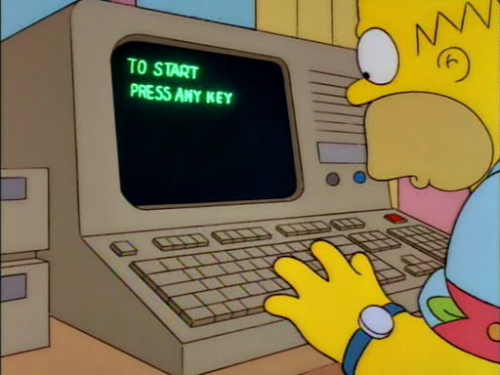
Where's The Any Key?!?

User experience has come a long way since the "dark ages" of DOS and the "any" key but there is still much progress to be made by many companies. To be successful, a company must engage customers and enable them to find what they're looking for in an easy and efficient manner.

A recent Mashable interview of Kare Anderson by Brian Solis, "Why Emotion Makes For Great Web Design" discusses the science behind a better user experience, specifically the science of emotions.  Anderson relates how understanding behavior cues in interpersonal relationships can help businesses provide a better experience between business and customer online. 

Better Listener

Anderson's talking points all boil down to the basic fact that companies (and people) need to be better listeners. 

Increased internet activity and the resulting "screen face" as she calls it are preventing people from truly connecting and being great listeners. She points to the popularity of Susan Cain's Quiet: The Power of Introverts in a World That Can't Stop Talking as a sign of people's increased feelings of introversion and isolation from others. If you read my post "Do I Fascinate You? Do I?!," you'll remember that as an INTJ this book hits close to home. 

Two cues Anderson mentions that I think are particularly true for combating this isolation and making for a better user experience is for a company to  
  • "find the sweet spot of mutual benefit"  
  • "get specific sooner." 

Mutual Benefit

A company will be unable to achieve these points unless they are actively listening to their customers. Customers will be turned off by a company if all it does is push advertisements and self-serving ads/tweets/facebook posts. Companies like Pampers and Kraft have been successful by creating content that benefits the consumer without the appearance of being self-serving. 

Customers appreciate when they feel that the company is there to help them whether it be soon-to-be or new parents looking for advice or a gamer looking for the newest game release.

Specific

The quicker a customer can find what they are looking for, the better an impression the company will make.

To the left is a screen shot from the "Games" page  at Electronic Arts

This page is a moderately successful showing of a good user experience. The page is set up so you may find games by platform, genre, release date and more, which allows you to find games by franchise, ESRB rating and type of gameplay. You are able to make a selection in each of the drop-down boxes allowing for a cross-reference and narrowing to a game that fits your criteria. 

This page also makes good use of white space, not too cluttered and features large graphics making it easy for gamers to find what they are looking for quickly by multiple methods.

Companies who master these two cues will find their customers happy and happy customers are loyal customers.